
 administrator
Aarvam IAS Academy has firmly established itself as the number one institute for Tamil literature optional coaching for the UPSC Civil Services Examinations. Its unparalleled success is built on a legacy of producing top rankers and thousands of successful candidates who have cleared the prestigious IAS exams.
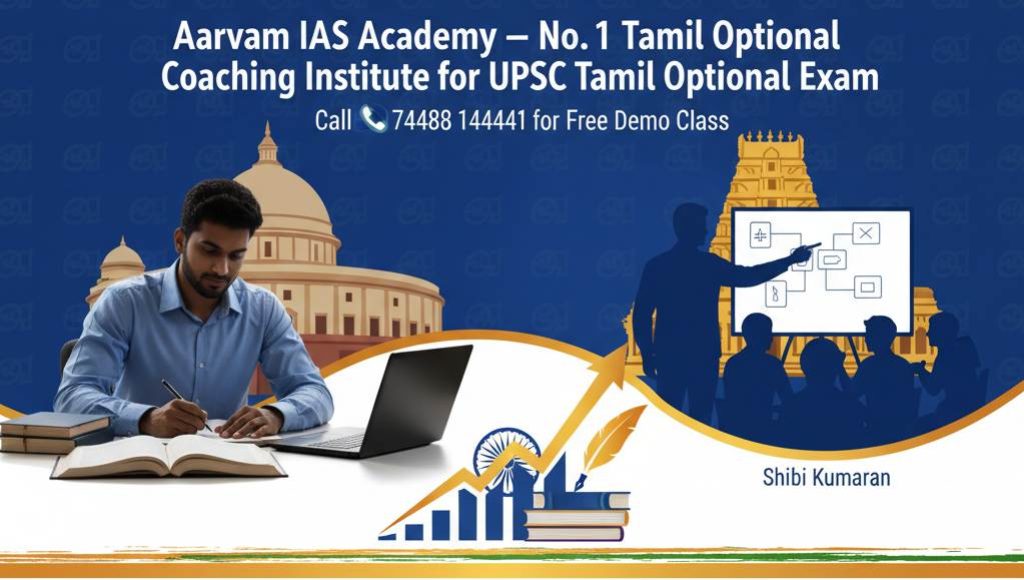
The academy’s pre-eminent position is primarily backed by the visionary leadership and scholarly expertise of Mr. Shibi Kumaran. A renowned authority on Tamil optional studies and a well-known figure in Tamil Nadu’s academic circles, his deep subject knowledge and strategic insights form the core of the academy’s pedagogy. Under his guidance, the curriculum is meticulously designed to demystify the syllabus, connect literary themes to contemporary issues, and equip students with the analytical depth required to excel in both the written exams and the personality test.
The results speak for themselves. Thousands of students have successfully cleared the IAS exams through Aarvam’s Tamil optional program, a testament to its effective teaching methodology, comprehensive study materials, and relentless focus on answer writing practice. This proven track record of consistently high success rates makes Aarvam IAS Academy the most trusted and result-oriented destination for aspirants choosing Tamil as their optional subject.
Unveiling the Potential: A Comprehensive Guide to Tamil Literature as a UPSC Optional
Choosing an optional subject for the UPSC CSE is a strategic decision that can significantly impact an aspirant’s final score and ranking. Among the 48 optional subjects available, Tamil Literature stands out as a compelling choice, especially for those with a proficiency and interest in the language. This article provides a detailed overview of the Tamil optional, demystifying its syllabus, preparation strategy, and its unique advantages.
Why Consider Tamil Literature as an Optional?
1. High Scoring Potential: Like other literature subjects, Tamil is known for its well-defined and static syllabus. Answers can be enriched with direct quotations from ancient and medieval texts, which examiners highly value, leading to high marks.
2. Overlap with General Studies (GS): The papers have significant overlap with the GS syllabus:
Paper-I (Language & History): Covers topics like the history of Tamil literature, which connects with Art & Culture (GS Paper-I). The sections on linguistic theories and cultural history provide excellent fodder for Essay papers.
Paper-II (Prescribed Texts): The poems and epics are replete with themes of ethics, governance, administration, and social justice, directly feeding into GS Paper-IV (Ethics, Integrity & Aptitude) and GS Paper-II (Governance).
3. Limited and Defined Syllabus: The syllabus is confined to a specific set of texts and topics. Unlike more dynamic subjects, the core content does not change, allowing for thorough and repeated revision.
4. Less Competition: A relatively smaller number of candidates opt for Tamil Literature compared to popular subjects like Public Administration or Geography. This can be a strategic advantage for well-prepared candidates.
Understanding the Syllabus
The Tamil optional consists of two papers, each carrying 250 marks, for a total of 500 marks.
—
PAPER-I: (History of Tamil Language and Literature)
This paper tests the candidate’s understanding of the evolution of the Tamil language and its literary history.
Section A: History of Tamil Language
1. Language Family: The place of Tamil in the Indian language family and its Dravidian roots.
2. Historical Development: The history of Tamil language with periods of Old Tamil, Middle Tamil, and Modern Tamil.
3. Dialects: Regional and social variations/dialects of Tamil.
4. Theories & Influence: Theories related to the origin of Tamil; the influence of Sanskrit and other languages on Tamil.
5. Etymologies: The process of producing new words (derivational morphology and compounding).
6. Linguistic Studies: The history and role of Tamil linguistic studies and commentaries (Tolkappiyam, Nannool, etc.).
7. Translation: Problems of translating works from other languages into Tamil and vice-versa.
8. Standardization & Modernization: Standardization of Tamil and the development of modern technical and scientific terminology.
Section B: History of Tamil Literature
1. Sangam Literature: A detailed study of Sangam works (Ettuthogai, Pathupattu) and the post-Sangam works (Pathinenkilkanakku).
2. The Epics: The five great epics: Silappathikaram, Manimekalai, Civaka Cintamani, Valayapathi, and Kundalakesi.
3. Devotional Literature: The Bhakti movement and its literature: Thevaram, Thiruvasagam, and Nalayira Divya Prabandham.
4. Secular & Didactic Literature: Secular narratives like Perunkatai and didactic works like Naladiyar, Thirukkural.
5. Medieval & Modern Literature: Folk literature, minor literary forms, the development of modern Tamil literature, including the impact of European missionaries and the role of periodicals.
6. Literary Genres: The evolution of various literary genres: novel, short story, drama, poetry, and literary criticism.
—
PAPER-II: (Prescribed Texts)
This paper requires a critical and in-depth study of specific literary texts. The answers must be written in Tamil, and the ability to quote relevant lines is crucial for scoring high marks.
This section is divided into three parts:
Part A: Ancient Literature
Tholkappiyam: (Porulathikaram – sections on Agam and Puram)
Kuruntogai: (1-25 poems)
Purananooru: (1-50 poems)
Thirukkural: (Arathuppal, Porutpal, Inbathuppal)
Part B: Epic Literature
Silappathikaram: (Padalam 1-15)
Manimekalai: (Padalam 1-15)
Civaka Cintamani: (Padalam 1-15)
Part C: Modern Literature
Novel: Ponniyin Selvan (Book 1 & 2) by Kalki Krishnamurthy.
Short Story: Selected stories from authors like Pudumaippithan, Jayakanthan, etc.
Poetry: Selected poems from Bharathiar, Bharathidasan, and Kannadasan.
Drama: Manonmaniam by Sundaram Pillai.
A Strategic Approach to Preparation
1. Start with the Syllabus & Previous Years’ Papers (PYQs): This is the first and most crucial step. Understand the exact demands of the syllabus and analyze PYQs to identify recurring themes and important topics.
2. Source the Right Study Material:
Primary Texts: Procure the original texts or authentic publications.
Standard Reference Books: Use well-regarded books and commentaries. For Paper-I, books on the history of Tamil literature by scholars like Mu. Varadarajan are essential. For Paper-II, detailed explanatory notes (Vilakkam) for the prescribed texts are invaluable.
Coaching Notes: For structured preparation, notes from reputed institutes like Aarvam IAS Academy, known for its expertise in this optional, can provide a significant edge. Their notes, often curated by experts like Shibi Kumaran, are tailored to the UPSC’s demand, providing thematic analysis and answer-writing frameworks.
3. Focus on Thematic Analysis: Don’t just read the texts; analyze them. For example, from Thirukkural, prepare notes on “Good Governance (Arasiyal),” “Ethics (Aram),” and “Wealth (Porul).” From Silappathikaram, you can derive themes like “The Power of Chastity (Karpu),” “Fate vs. Human Effort,” and “Social Justice.”
4. Master Answer Writing: This is the key to scoring high.
Structure: Write answers in a structured format with an introduction, body, and conclusion.
Quotations: Liberally use relevant quotations from the texts to substantiate your points. This demonstrates in-depth knowledge.
Interdisciplinary Linkages: Connect your answers to GS topics. For instance, while writing about the administration in Silappathikaram, link it to modern-day principles of governance and justice.
Practice: Regularly write answers and get them evaluated by a mentor or a peer group.
5. Revision is Non-Negotiable: The vast number of texts and poems requires constant revision. Create short notes, flashcards for important quotes, and mind maps for literary history to make revision efficient.
Challenges and How to Overcome Them
Volume of Texts: The syllabus, especially Paper-II, is vast. The key is to prioritize based on PYQs and focus on understanding the core themes of each text rather than rote memorization.
Answer Writing in Tamil: For those not accustomed to writing long-form answers in Tamil, this can be a hurdle. Regular practice is the only solution to develop the necessary speed, flow, and vocabulary.
Finding Quality Guidance: Unlike mainstream optionals, finding expert guidance for Tamil can be challenging. This is where specialized academies and dedicated mentorship programs prove their worth.
Conclusion
Tamil Literature is not just a subject for Tamil scholars; it is a strategic tool for a discerning UPSC aspirant. It offers a rare combination of scoring potential, interesting content, and significant overlap with the General Studies papers. With a structured plan, dedicated effort, and a passion for the language’s rich heritage, mastering the Tamil optional can be the decisive factor in realizing the dream of becoming a civil servant. For thousands of successful candidates, particularly from Tamil Nadu, this path, often guided by institutions like Aarvam IAS Academy, has proven to be a road less traveled but one that leads directly to success.

